
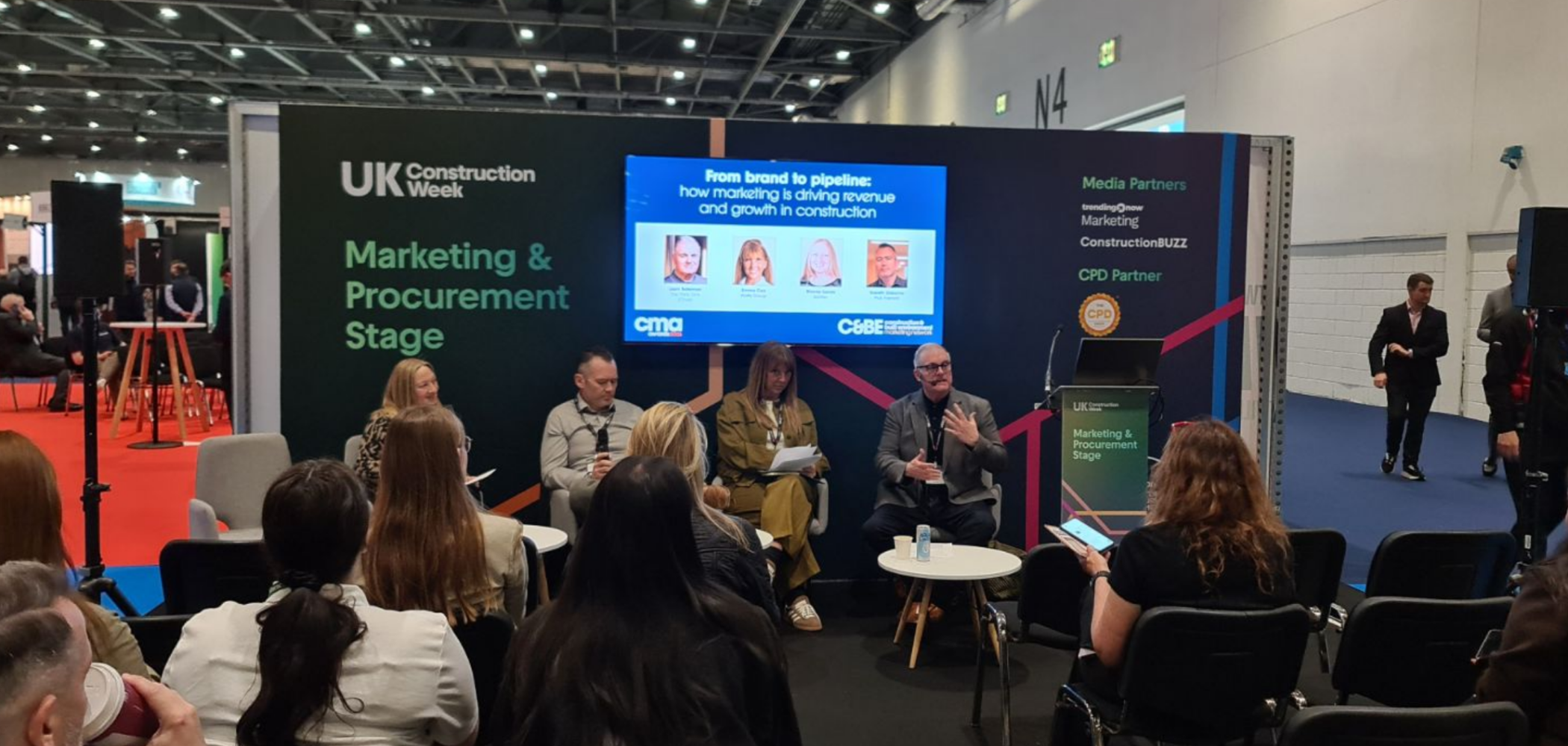
On 13th May 2026, Liam Bateman, Managing Director of The Think Tank, chaired a panel discussion at UK Construction Week about the challenges facing construction marketers. Here’s our round-up of all the key takeaways.
Construction marketing is under more scrutiny than it’s been in years. Pipelines are harder to predict, boards want a clearer line from spend to commercial outcome and marketing teams are being asked to sit closer to the bid table than ever. That was the backdrop for “From brand to pipeline: how marketing is driving revenue and growth in construction”, a panel event at UK Construction Week on Wednesday 13th May.
The Think Tank’s Liam Bateman chaired the panel, joined by Emma Cox (Watts Group), Gareth Osborne (Pick Everard) and Stacey Lucas (Sontay Ltd and former President of the BCIA). The conversation covered attribution, AI, internal influence and where the best commercial wins are actually coming from.
Here’s the five takeaways that stood out.
1. Construction marketing’s role is broader than businesses recognise
The panel was clear that construction marketing has moved well beyond campaigns and collateral, with Emma framing marketing’s role as making the business “easier to trust and easier to see”. As Stacey put it, packaging, customer service, reputation, training, technical support and the way people experience a business all form part of the marketing picture.
To earn recognition for that breadth of influence, the panel agreed, marketers have to immerse themselves in the business, the industry and the product, not just the campaigns.
2. Marketing has to prove its commercial worth
If construction marketing wants to be seen as a commercial function rather than a cost centre, it has to demonstrate commercial value. The panel agreed that although long buying cycles and relationship-led decisions can make attribution hard, marketers still have to find ways to prove their contribution.
Gareth named attribution as his number one challenge, particularly when talking to senior leaders. “It’s great to report campaign engagement and campaign stats, but the higher I go up in the business, the more commercially focused that conversation needs to be.” His answer is to make marketing’s influence on pipeline visible internally, and to link campaigns back to revenue wherever possible.
Emma made a related point about reporting itself: “Anything you report on should change behaviour.” The job is to build a body of evidence that the commercial team understands and respects, including pipeline influence, specification wins and campaigns tied to revenue.
3. The middle of the funnel is where most deals are quietly decided
While top-of-funnel awareness and bottom-of-funnel conversion get most of the attention, the panel agreed that the long middle is where construction marketers under-invest, and where buyers are doing the real work of comparing, shortlisting and deciding.
Emma argued for “targeted influence” as early as possible, shaping a buyer’s thinking before they’ve defined their pain points rather than waiting to respond once they have.
“You need to be consistent, but you also need to have relevant content that engages,” said Gareth. He also pointed out that in a market where AI is flooding inboxes with generic content, the quality bar has gone up. One sharp piece of insight has a far better chance of moving the needle than a series of recycled blog posts.
4. The biggest wins come from breaking silos
Some of the strongest commercial wins shared on the panel came from marketing joining the dots between sales, technical teams, distribution partners and end users. Training academies, specification tools and compliance campaigns don’t sit neatly in one department, which is exactly why marketing should lead them.
In professional services, Emma said her biggest role is tying teams together so that technical expertise doesn’t stay trapped in siloes. Similarly, Stacey described the practical work of aligning specification activity, CPDs, sales teams and distribution partners when a buying cycle can run for two years or more.
One example stuck with Liam regarding a meeting with a paint manufacturer, as he recalled how the marketing manager had pulled salespeople directly into campaign discussions. “Breaking down those silos is so, so important,” said Liam.
5. Use AI, but human judgement runs the show
The panel was pragmatic about where AI earns its place. At Sontay, Stacey described a chatbot introduced after rigorous testing to support international customers and help users find product information.
Watts has gone down a different route, with an internal tool Emma talked about that searches capability statements and case studies for bids. Over at Pick Everard, Gareth said the focus is mainly on research and early-stage production, but human judgement still owns the final outputs.
The shared view was that AI is useful for the work behind the work, not for the work that goes out the door. “I would hate people to look at our content and go, ‘there’s been some AI on that,'” said Gareth. In a trust-led industry, sloppy AI content is a fast way to undo years of credibility, and as Stacey pointed out, the call on how much expertise to share is “where AI can’t make that call for you.”
The bigger picture for construction marketers
Across all five takeaways, a clear theme emerged. Construction marketing is being asked to do more, prove more and influence more than it has before.
The marketers making the biggest commercial impact are the ones immersed in the business, comfortable talking the language of pipeline and revenue, willing to lead across silos and disciplined about where AI helps and where human judgement has to stay in charge.